November 16, 2026
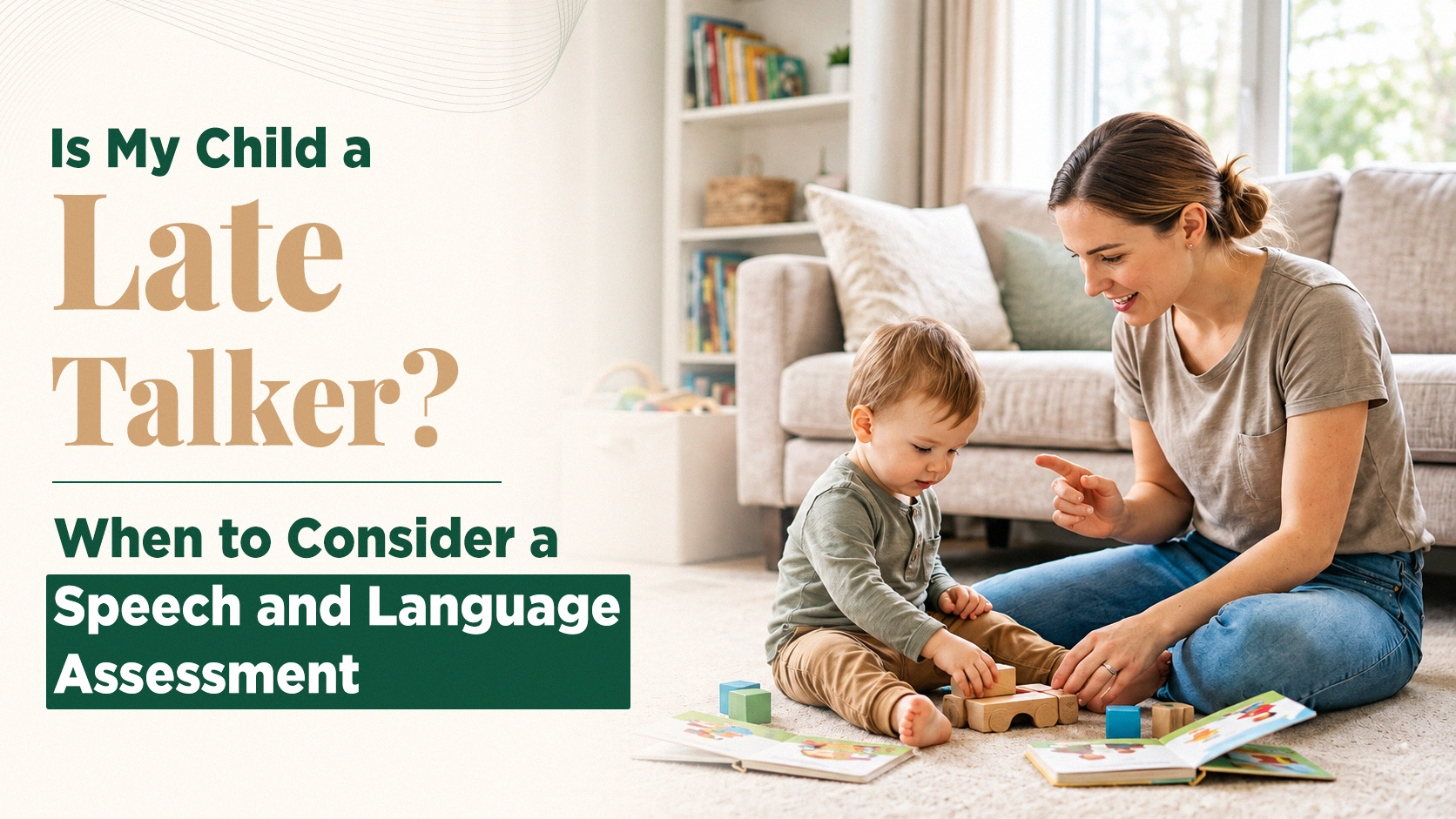
At the daycare door, another toddler chats with the staff. Your child waves, points at the toy bin, and hums along. Grandparents say talking will come in its own time. You value your child’s way of communicating, and you also want to understand it.
Quick answer: A late talker is generally a toddler who uses fewer spoken words than expected for their age, often despite relatively strong understanding and other developmental skills. A speech and language assessment with a speech-language pathologist (SLP) can show what is behind this pattern. At Aria Integrated Care, families can ask about a toddler speech and language assessment when words seem limited around 18 to 24 months.
What Is a Late Talker?
A late talker is generally a toddler who uses fewer spoken words than expected for their age, often despite relatively strong understanding and other developmental skills. Some children primarily experience difficulty using words, while others may also have difficulties understanding language, using gestures, or communicating socially. A speech-language assessment helps identify the child’s individual communication profile.
Late talking reflects how a child’s language is developing, and caregivers play a central role in supporting it. Some late talkers begin using words in their own time. Others continue to need support with language. Early on, the two paths can look alike, and some patterns cannot be told apart without an assessment.
Signs Your Toddler May Be a Late Talker
These are general developmental guidelines, and children develop at different rates. These signs may be worth discussing with an SLP:
- Around 18 months: Your child is using very few or no consistent, meaningful words.
- Around 24 months: Your child is using fewer than approximately 50 words or is still building toward combining two words, such as “want milk” or “uncle come”
- At any age: Your child has difficulty understanding familiar directions, uses limited gestures to communicate, or has lost words or communication skills they previously used.
- A concern that stays with you, even when others reassure you.
One sign alone does not point to a diagnosis. An SLP looks at the whole pattern, including understanding, gestures, play, and interaction.
Late Talker, Speech Delay, or Something Else?
Parents often use “toddler speech delay” for several different patterns.
| Pattern | What it describes | What an assessment may explore |
| Late talker | Fewer spoken words, with typical understanding and play | Vocabulary, word combinations, hearing |
| Language delay | Differences in understanding, using words, or both | Understanding, expression, and communication in daily life |
| Speech sound difficulty | Words are present but hard to understand. | Sound production and clarity |
Late talking can also appear alongside hearing differences, autism, or developmental language disorder (DLD, a lasting difficulty understanding and using language). Our SLPs look at the full picture, so support fits your child.
What If My Child Is Growing Up With Two Languages?
Children who grow up hearing or using two or more languages may develop vocabulary across those languages. Learning more than one language does not cause a speech or language disorder. When assessing a multilingual child, an SLP considers communication skills across the child’s languages, rather than looking only at English vocabulary. Families should continue using the languages they are most comfortable speaking at home.
When assessing a multilingual child, an SLP considers communication skills across all of the child’s languages and looks beyond English vocabulary alone. Families can keep using the languages they feel comfortable speaking at home.
When to Consider a Speech and Language Assessment
Consider reaching out when any of the signs above feel familiar or when your instinct says something is worth checking. You do not need to wait until age three.
If you are wondering when to see a speech therapist for a toddler, an assessment is a reasonable place to start. If your 18-month-old is not talking yet or your 2-year-old uses very few words, an assessment can help you understand what may be happening.
A hearing check is a helpful companion to any speech concern, and your pediatrician or family doctor can guide you there. For a closer look at checkpoints by age, see our guide to speech and language red flags by age.
Ready to talk through what you are noticing? Contact our team to enquire about an assessment for your child.
Enquire About a Speech Assessment
How Aria’s Speech and Language Assessment Works
Every family’s situation is different, and the process is built around your child. It generally follows four steps:
- Caregiver discussion: You share what you notice at home, your child’s strengths, developmental history, the languages your child hears and uses, and your goals.
- Child-centred assessment: Your SLP looks at understanding language as well as spoken language, along with gestures, social communication, play, and interaction, in a way that suits your child’s age and comfort.
- Clinical interpretation: Your SLP reviews what was seen and heard alongside your family’s story, your child’s languages and cultural background, and any hearing-related concerns.
- Findings and recommendations: You receive a clear explanation and suggested next steps, which may include a recommendation for a hearing check or another referral when appropriate.
Next steps may include strategies for daily routines, a plan to monitor progress, or speech therapy. An assessment gives you information. Therapy begins only if you choose it.
Assessment methods depend on your child’s age, needs, clinical presentation, and reason for referral, and the tools used can differ from one child to the next. For a fuller walkthrough, see what happens during a speech and language assessment for children.
What Support Can Look Like
When speech therapy for toddlers is recommended, goals connect to everyday life. Examples include asking for a snack, joining a game with a sibling, or telling a caregiver what hurts.
Support may include:
- Play-based sessions that follow your child’s interests and build words, gestures, and understanding
- Coaching for caregivers, so support continues between sessions
- Goals shaped by your child’s strengths and communication style
- Collaboration with our occupational therapists or behavioural therapists when other skills affect communication
Communication takes many forms, including speech, gestures, pictures, and devices. Our goal is meaningful, functional communication in whichever form fits your child.
Ways to Support Language at Home
Your SLP can tailor ideas to your child. Many families start with these:
- Narrate routines: “Splash, the water is warm” during bath time.
- Offer choices: Hold up two snacks and wait for a look, point, or word.
- Pause: Leave a few seconds after you speak.
- Share books and songs: Short, repeated favourites work well.
- Respond to gestures and sounds: These are communication.
- Add a little: When your child communicates through a sound, gesture, or word, respond naturally with a slightly longer message, without asking them to repeat it. If your child says “car,” you might say, “Yes, red car.”
Asking a child to say a word on demand can feel stressful. Offer chances, and let your child choose when to use words.
Toddler Speech Therapy and Assessment in Greater Vancouver
Aria Integrated Care provides pediatric speech-language assessment and therapy services in select Greater Vancouver communities, including Burnaby, with in-home and other service options depending on location, clinician availability, and clinical suitability. When therapy takes place at home, it happens where your child eats, plays, and communicates each day. Caregivers take part throughout.
You can read about our pediatric speech therapy services or see how to access speech therapy in British Columbia. Our team can also confirm availability in your area.
Key takeaway: A late talker may catch up in their own time or may benefit from support. An assessment gives clear information so you can choose next steps with confidence.
Wondering whether your toddler’s speech and language development is on track? Aria Integrated Care offers pediatric speech-language assessments to help families better understand their child’s communication skills and possible next steps.
Contact our team to enquire about an assessment for your child. Enquire About a Speech Assessment
Frequently Asked Questions
1. Is 18 months too early for a speech-language assessment?
Parents can ask whenever a concern arises. An assessment at 18 months can show how your toddler is understanding and communicating and whether strategies at home or follow-up support could help.
2. My 2-year-old understands everything but isn’t talking. Should I be concerned?
Some toddlers understand a great deal and use few words, which is one pattern seen in late talkers. Because understanding and speaking can develop differently, an assessment looks at both, along with gestures and social communication.
3. How many words should a 2-year-old say?
Children develop at different rates. As a general guideline, children around 24 months are often using about 50 words and beginning to combine two words, such as “want milk.” If your child uses fewer words, an SLP can explain what may be happening.
4. Can growing up bilingual cause speech delay?
Growing up with two languages is not linked to speech or language disorders. Bilingual children can build vocabulary across both languages, so an SLP considers all the languages your child hears and uses. You can keep speaking the languages you feel comfortable using at home.
5. What happens during a toddler speech-language assessment?
An SLP talks with you about your child’s development, observes understanding, gestures, play, and speaking, and considers the languages your child hears. Noting a few words you hear at home can help. Methods depend on your child’s age and needs.
6. How can I support my late talker at home?
Follow your child’s interests, pause to give them time to respond, offer two choices, and answer sounds and gestures with a slightly longer message. Short books and familiar songs give repeated chances to hear words. Your SLP can tailor these ideas.
7. Is in-home speech therapy available in Greater Vancouver?
Aria Integrated Care provides pediatric speech therapy in select Greater Vancouver communities, with in-home and other service options depending on location, clinician availability, and clinical suitability. Contact our team to confirm availability in your area.
8. Can extended health benefits or BC funding help cover speech therapy?
Some families may be able to offset costs through BC funding programs or extended health benefits depending on eligibility and coverage. Our BC funding page outlines the options, and our team can talk through how they may apply to your situation.
9. Do late talkers catch up on their own?
Some late talkers begin using words in their own time, and others continue to need support with language. Early on, the two paths can look alike, so an assessment helps clarify what your child may need and which strategies could help.
10. What should I do if my toddler loses words or skills?
Speak with a doctor promptly if a toddler loses sounds, words, or skills they once had. An SLP can also assess communication, and your doctor can guide any hearing check or next steps.