November 13, 2026
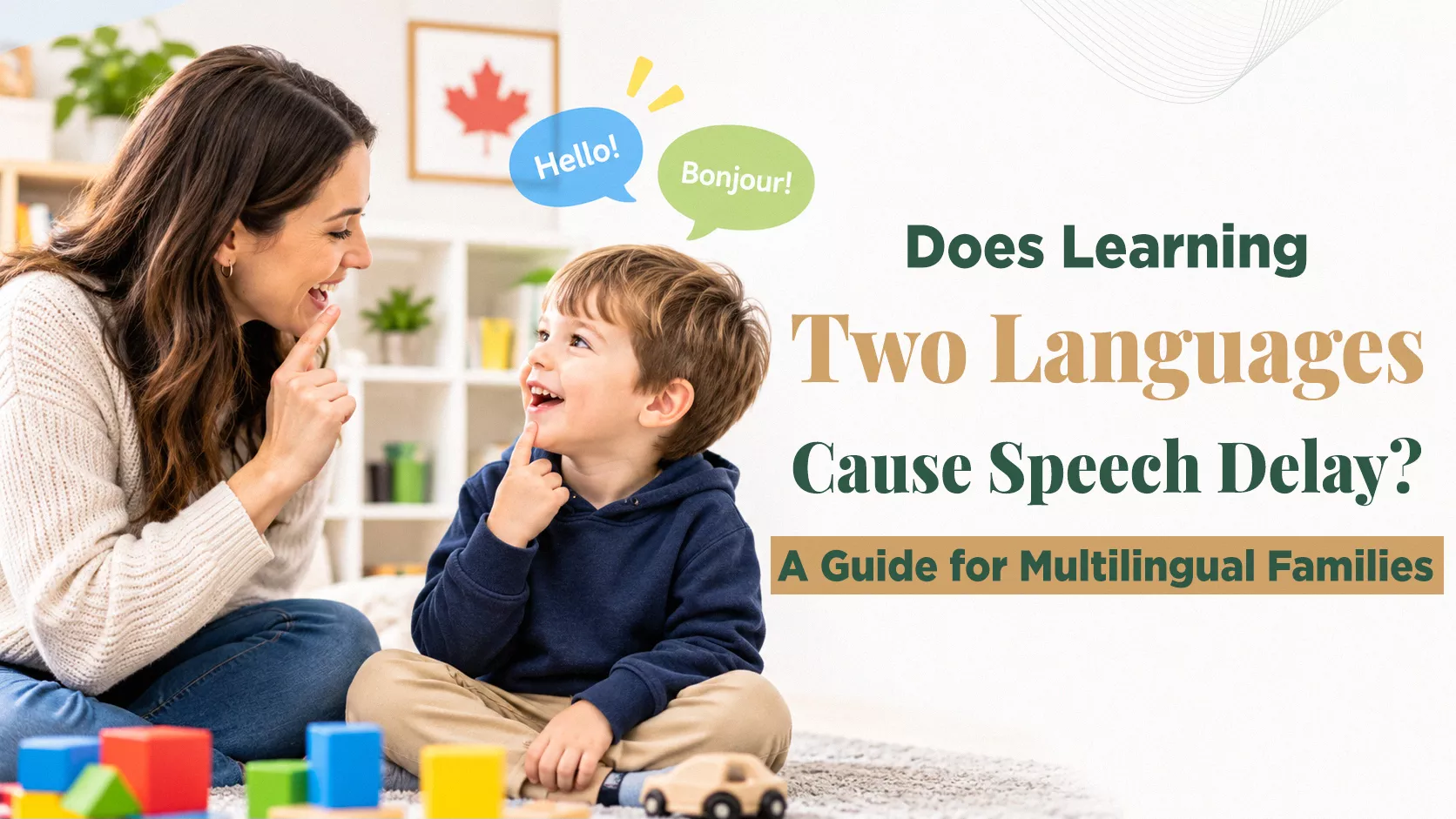
Picture a two-year-old who asks for milk one way at daycare and another way at her grandparents’ table. Her parents hear two words where a friend’s child uses one. A relative suggests choosing a single language until she catches up.
Learning two languages has not been shown to cause speech delay. Children around the world learn two languages or several without developing speech or language problems, according to the American Speech-Language-Hearing Association (ASHA). A bilingual child can still have a speech or language delay. When that happens, it has other causes. The difficulties may affect communication across a child’s languages, although they may look different depending on language exposure and proficiency.
Key points
- Count words across both languages together. English words alone give a partial picture.
- Mixing two languages in one sentence is a common part of bilingual language development.
- Speech and language difficulties may affect communication across a child’s languages, and a speech-language pathologist (SLP) considers skills across languages and settings.
What the evidence says about two languages and speech delay
ASHA reports that many bilingual children say first words around age one and begin combining two words by age two. Those are the same milestones seen in children who learn one language. How each language develops depends on the amount and type of language the child hears in it.
Two terms help here. Speech is how sounds are made. Language is understanding and using words and sentences. A child can have difficulty with one or both, and the question of bilingual speech delay usually involves both.
Bilingualism also sits alongside other differences. A School District 41 (Burnaby) SLP blog notes that two languages do not cause confusion or language delay. That holds for children with a developmental delay or a diagnosis such as autism or Down syndrome. Children with developmental differences can learn two languages too.
Why it can look like a delay
Four everyday patterns often get read as delay. Each has a common explanation.
| What families notice | A common explanation | Worth raising with an SLP if |
| Fewer English words than a same-age cousin | Words are split between two languages, so counting one language undercounts | Total words across both languages seem limited, or the child uses few words in any language |
| Two languages in one sentence (code-mixing) | The child draws on both languages to get a message across | The child has trouble forming simple sentences in either language when only that language is in use |
| A quiet stretch after a new language begins | Some children listen first when a second language starts later (a silent period) | The quiet stretch continues and the child also says little in the home language |
| Falling behind a milestone checklist | Many checklists are built on single-language data | Understanding, gestures, or play with others also seem limited |
That last row deserves attention. ASHA states that its communication milestones are based on American English speakers. Children learning other languages may follow a different sequence or pace. A checklist can raise a question. It cannot settle one.
The both-languages check
Families often ask how to tell a language difference from a delay. This four-step check gives a starting point before any appointment.
- Consider your child’s vocabulary across all languages. For example, if your child says both “agua” and “water”, these count as two words when measuring total vocabulary but one concept when measuring conceptual vocabulary. An SLP may consider both measures when assessing multilingual development.
- Listen for understanding in each language. Does the child follow a simple direction? Point to a named object? Respond to their name in the home language?
- Look across settings. A child may talk freely at home in one language and say little at daycare in the other. That can reflect how much of each language the child hears.
- Watch the direction over weeks and months. New words in either language are an encouraging pattern. A stall in new words is worth discussing with an SLP, who considers skills across languages and settings.
Speech and language difficulties may affect a child’s communication across their languages, although they may look different depending on language exposure and proficiency. An SLP considers the child’s skills across languages and settings when determining whether further assessment is needed.
Signs that may call for a speech and language assessment
These signs can be associated with a speech or language delay. None of them diagnoses a child, and an assessment can help determine what is behind them.
- Few or no words in any language, or limited gestures such as pointing and waving
- Difficulty following simple directions in the home language as well as English
- Speech that familiar listeners find hard to understand in the home language
- Loss of words or social skills the child had before
- Frustration when trying to communicate, or little back-and-forth with others
A hearing check may also be part of the picture when a child has speech or language concerns. For age-by-age examples, see our guide to speech and language red flags by age. For toddlers who are slower to start talking, read why some toddlers struggle to communicate.
Should you stop using a home language?
Keeping the home language is the guidance many clinicians give families in this situation. A clinical Q&A in Canadian Audiologist says that stopping the home language does not help a child overcome an underlying disorder. The same source points out that many SLP strategies increase the amount and type of language a child hears.
The School District 41 SLP blog suggests that families speak to their child in the language they use with the greatest ease. A likely reason is that a fluent speaker tends to offer richer vocabulary and longer sentences, which gives the child better models.
Home languages also carry family connection. A child who shares a language with grandparents can talk with them directly.
Common mistakes
- Switching the whole household to English on a relative’s advice
- Comparing a child’s English words with a peer who hears only English
- Correcting mixed sentences, which can make a child hesitant to speak
- Treating a single-language milestone checklist as a verdict
- Asking a child to pick one language
Everyday ways to support both languages
Support works best when it fits routines a family already has. These steps suit ages from toddler to preschool, and each can be adapted to the child.
- Speak the language you know best. Fluent speech gives your child the best model, whichever language it is.
- Attach a language to a routine. Mealtime, bath, bedtime, and car rides give children repeated, predictable phrases.
- Narrate in short phrases, then pause. “Shoes on. Your turn.” Waiting a few seconds gives the child room to respond.
- Read and sing in both languages. Library board books and songs from family can serve as shared activities.
- Reply to mixed sentences with the full sentence. If a child says “I want leche,” try “You want leche. Let’s get your leche.” The child hears a complete model, and nothing gets corrected.
Tip: A mixed sentence is a message. Answer the message first, then model the full sentence.
What an assessment can look like for a multilingual child
A speech and language assessment for a bilingual child looks at all the languages the child hears and uses. The SLP typically asks which languages are spoken and when the child started each one. Questions also cover how much the child hears daily and who speaks each language.
An SLP considers the child’s language exposure, communication history, and skills across their languages. When needed, information from family members, caregivers, or interpreters can help provide a more complete picture of the child’s communication abilities.
This overlaps slightly with the later sentence about gathering detail from the family and working with an interpreter. Both can stay, or the later one can be trimmed.
An assessment may include:
- A parent interview about the child’s communication at home, daycare, and school
- Observation during play
- A sample of the words and sentences the child uses
- Tasks that check understanding
- A discussion of hearing
Many tests and checklists were built on single-language data, so results are weighed alongside what the family reports. Goals then focus on everyday life: asking for a snack, joining a game, following a routine at school.
Families often ask whether the SLP must speak their language. ASHA has recommended consulting a bilingual SLP who knows the rules of both languages when possible. When that is not available, some clinicians gather detailed information from the family about the home language and work with an interpreter. It helps to ask any clinic how it handles your child’s languages before booking.
One shift worth watching: virtual sessions let families across British Columbia reach clinicians outside their own city. That can widen options for a family looking for a particular language.
Speech therapy for bilingual children in Vancouver and across BC
Aria Integrated Care provides pediatric speech therapy in homes in Vancouver, Burnaby, Richmond, Delta, New Westminster, and the Tri-Cities (Port Moody, Port Coquitlam, and Coquitlam), and virtually across British Columbia. At home, a child’s routines, toys, and family languages are already in the room. Strategies can be tried where communication happens.
If bilingual speech delay is a concern, a child speech assessment in Vancouver or by video can look at every language your child uses. When you contact the team, share which languages your child hears and uses. Ask how the assessment will account for them.
Key takeaways
- Children can learn two languages and reach the same early milestones as children learning one.
- A fair picture counts words and understanding across both languages.
- Speech and language difficulties may affect communication across a child’s languages, and an SLP considers skills across languages and settings.
- Keeping the home language gives a child richer language to learn from.
At Aria Integrated Care, we support multilingual families in understanding their child’s communication development. If you have concerns, contact our team to learn more about pediatric speech and language assessment options in your home in select Greater Vancouver communities or virtually across BC. To plan next steps, see how to access speech therapy for your child in BC and how BC funding programs can help with costs.
Frequently Asked Questions
1. Does learning two languages cause speech delay?
Learning two languages has not been shown to cause speech delay. Bilingual children follow the same early milestones as other children. A delay has other causes, and an assessment can help find them.
2. Can bilingual children have a speech delay?
Yes. Bilingual children can have a speech or language delay, just as children learning one language can. These difficulties may affect communication across a child’s languages, although they may look different depending on language exposure and proficiency. An SLP considers the child’s skills across languages and settings.
3. Should I stop teaching my child two languages if they have a speech delay?
Clinicians advise keeping the home language. Dropping it has not been shown to resolve an underlying delay, and many SLP strategies increase the language a child hears. An SLP can guide your plan.
4. Is it normal for bilingual children to mix languages?
Mixing languages in one sentence is common in bilingual development. A child may use words from both languages to get a message across, and the mixing often lessens with age.
5. When do bilingual children start talking?
ASHA reports that many bilingual children say first words around age one and use two-word phrases by age two, in one or both languages. Every child develops at an individual pace.
6. Are speech and language milestones different for bilingual children?
The early milestones are similar, but many checklists use single-language data. ASHA notes its own milestones are based on American English speakers, so a checklist can raise questions without settling them.
7. How is a bilingual child assessed for speech delay?
An SLP looks at every language the child hears and uses. This may include a parent interview, play observation, a language sample, understanding tasks, and a hearing discussion.
8. Do I need a bilingual speech therapist?
ASHA has recommended a bilingual SLP when one is available. Otherwise, some clinicians gather detail from the family and use an interpreter. Ask any clinic how it handles your child’s languages.
9. Can speech therapy for bilingual children happen at home?
Yes. In-home sessions let strategies fit the routines, toys, and languages already part of family life. Aria provides in-home pediatric speech therapy in Vancouver, Burnaby, Richmond, Delta, New Westminster, and the Tri-Cities.
10. Is virtual speech therapy available for children in BC?
Aria offers virtual speech therapy across British Columbia where clinically appropriate. Virtual sessions can suit families outside Greater Vancouver or those who prefer to attend from home.