August 13, 2026
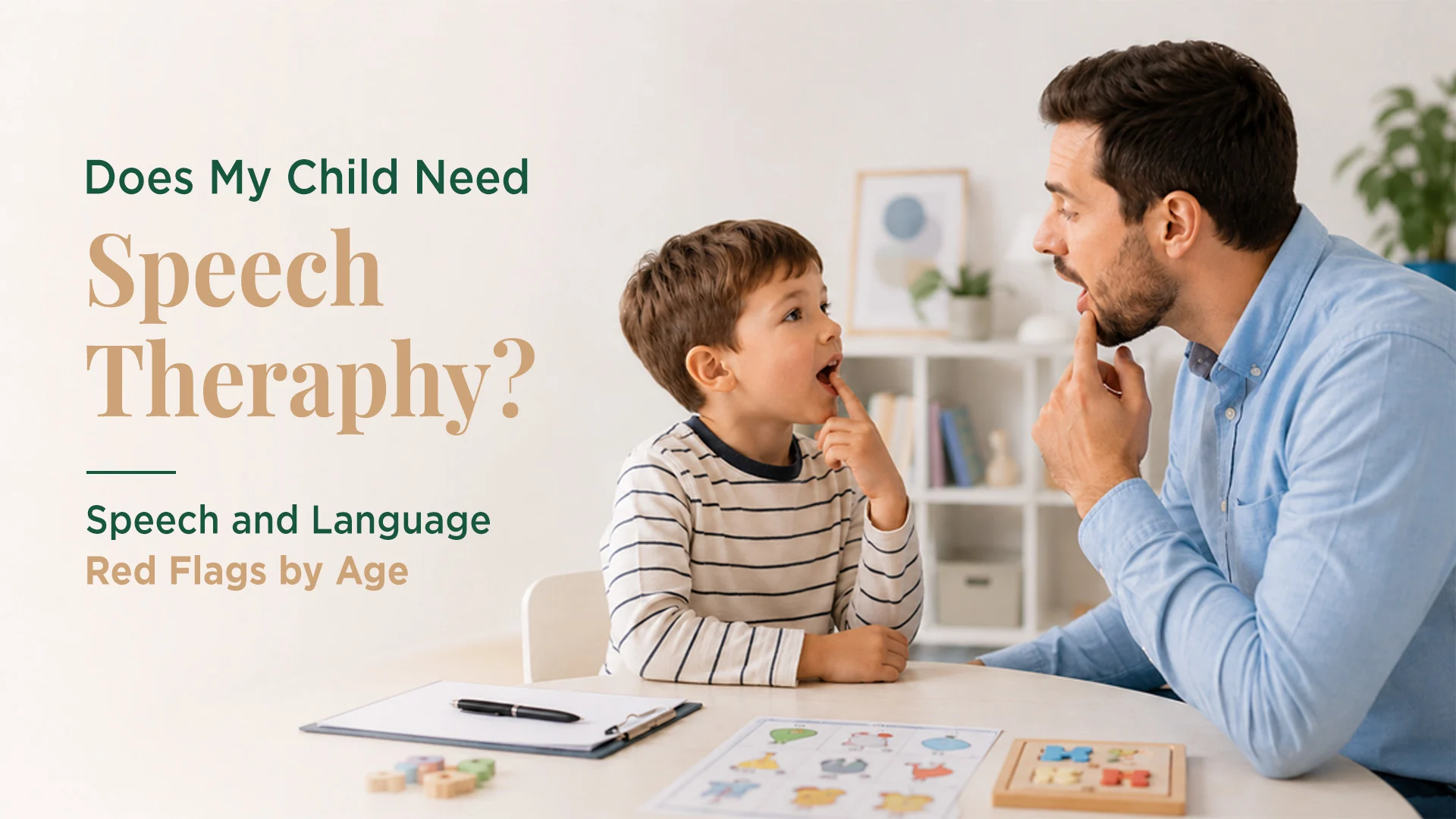
Your toddler points instead of asking. Your three-year-old still uses single words while their cousin speaks in sentences. You’ve mentioned it to your pediatrician and heard “let’s wait and see.”
Every child develops on their own timeline, but there’s a real difference between a passing phase and a pattern that persists across months and settings. This guide covers what to expect by age.
Why “Wait and See” Isn’t Always the Safest Bet
Children develop at different rates, but ongoing concerns about how a child understands, expresses, or uses communication are worth discussing with a professional.
Pediatricians aren’t being dismissive when they say “wait and see.”Language development genuinely varies across a wide range of what’s typical, and persistent concerns can be checked by an SLP. But research from public health bodies like the CDC has shown that early intervention during the toddler and preschool years takes advantage of a period when the brain is especially responsive to language input. When concerns persist, an SLP consultation can help determine whether monitoring, parent strategies, further assessment or therapy may be appropriate.
If you’re asking ‘does my child need speech therapy,’ the fact that you’re asking is worth paying attention to.
Speech and Language Milestones by Age: 12 Months
By their first birthday, most babies are experimenting with sound in a fairly recognizable way.
What’s typical:
- Babbling with changing intonation, almost like they’re “talking” in their own language
- Using a few gestures: waving bye-bye, pointing at something they want
- Responding to their name
- Understanding simple words like “no” or “bottle,” even if they can’t say them yet
What might warrant a closer look:
- No babbling or vocal experimentation at all
- No response to their name by 12 months
- Limited gestures, limited attempts to communicate, reduced response to sounds or voices, or limited sharing of attention or interest
- Limited use of gestures or pointing to show interest in something
One missing item here usually isn’t a red flag on its own. A cluster of them is worth mentioning at your next pediatric visit.
18 Months: The Word-Count Checkpoint
This is often the age where parents start comparing notes with other families, and it’s a reasonable one to pay attention to.
What’s typical:
- A vocabulary of at least 10 to 20 words (general reference range, not a diagnostic cutoff)
- Pointing to ask for things or show you something interesting
- Following simple one-step directions (“bring me the ball”)
- Combining a word with a gesture, like saying “up” while reaching
Red flags at 18 months:
- A notably small vocabulary for this age may be worth discussing with an SLP
- No combination of gesture and word together
- Difficulty understanding simple directions without visual cues
- Loss of any words or sounds the child previously used
A toddler not talking at 18 months isn’t automatically cause for alarm. If a low word count, limited gestures, and difficulty understanding simple requests are all present together, that combination may be worth discussing with an SLP.
24 Months: Two-Word Combinations
By age two, most toddlers are stringing ideas together, even short ones.
What’s typical:
- Vocabulary under 50 words (these numbers are general reference points, not diagnostic cutoffs)
- Combining two words into short phrases: “more juice,” “daddy go”
- Being understood by familiar listeners roughly half the time
- Following two-step directions (“get your shoes and bring them here”)
Red flags at 24 months:
- Vocabulary under 50 words
- No two-word combinations
- Speech that’s largely unintelligible even to parents
- Strong reliance on gestures instead of words to communicate needs
- Noticeable frustration or meltdowns when they can’t get their message across
Some children may become frustrated when they have difficulty communicating what they want, need, or feel. An SLP can help identify communication strengths and needs and support the child and family with strategies that make everyday communication easier and more effective.
Ages 3 to 5: When Speech Should Be Clear and Conversational
Between three and five, language shifts from single requests to actual back-and-forth conversation. This is also the age range where speech sound clarity becomes a bigger focus.
What’s typical:
- Speaking in full sentences of four or more words by age 4
- Being understood by unfamiliar listeners most of the time by age 4 to 5
- Asking and answering “wh” questions (who, what, where)
- Telling a simple story or recounting part of their day
- Using grammar markers like plurals and past tense, even if imperfectly (“I goed to the park”)
Red flags between 3 and 5:
- Difficulty combining words into phrases or sentences appropriate for their age
- Difficulty understanding questions or following age-appropriate directions, especially multi-step ones
- Speech that is difficult for family members or unfamiliar listeners to understand, well past the age where that’s typical
- Avoiding talking in group settings or with unfamiliar adults
- Frequent or persistent stuttering, physical tension while speaking, avoidance of talking, or frustration or distress related to speaking may be reasons to consult an SLP
- Loss of previously acquired speech or language skills, at any age, is always worth an immediate conversation with a professional. Regression is different from a slow pace. It’s a signal that shouldn’t wait.
If you have ongoing concerns about your child’s communication development in this age range, an SLP consultation or assessment can help you better understand their strengths and needs.
When the Pattern Points to Autism or Gestalt Language Processing
Children can develop and use language in different ways. Some autistic children may use echolalia, scripts or longer memorized phrases as part of their communication. These phrases may have communicative meaning, so an SLP can look at how and when a child uses them and what the child may be communicating. Some families and clinicians may also hear this described in relation to Gestalt Language Processing (GLP).
Repeating lines or scripts from favorite shows may have communicative meaning, even when the connection isn’t immediately obvious to the listener.
At Aria, we take an individualized, neurodiversity-affirming approach and support different forms of communication, including speech, gestures and AAC when appropriate.
What a Speech and Language Assessment Actually Involves
If you have ongoing concerns about your child’s communication development, an SLP consultation or assessment can help you better understand their strengths and needs. The next step isn’t a diagnosis. It’s a conversation.
A speech-language assessment can vary depending on the child, their age and the specific concerns. It may include a parent or caregiver interview, observation, play or conversation, formal or informal assessment measures, and a review of speech, language and functional communication as appropriate. You’ll get clear, honest feedback afterward: sometimes that’s a plan for therapy, and sometimes it’s genuine reassurance that your child is developing within a wide, normal range.
Trust What You’re Noticing
You know your child better than any checklist does. If something has felt “off” for a while, and now you’ve read through specific speech delay red flags that match what you’re seeing, that’s not a coincidence. That’s useful information.
Early support gives your child the tools to thrive sooner, and a short conversation now is a small step compared to months of uncertainty.
Book a Free 20-Minute Consultation with Aria Integrated Care, and let’s figure out, together, what your child needs.
Your Questions About Speech Therapy, Answered
- Does my child need speech therapy?
An SLP assessment can provide a clearer picture of your child’s communication strengths and needs, and help determine whether monitoring, strategies or therapy may be appropriate. - What are the speech and language milestones by age?
Most toddlers say 10+ words by 18 months, combine two words by 24 months, and speak in full sentences by age 4. Missing several signals it’s worth a check. - What are common speech delay red flags?
Key signs include a small vocabulary for their age, trouble combining words, unclear speech, limited gestures, and frustration during communication attempts. - My toddler isn’t talking at 18 months. Is that normal?
Some variation is normal. If a small vocabulary, limited gestures, and difficulty following directions are all present together, an SLP assessment may help clarify next steps. - What does a speech and language assessment involve?
An SLP observes your child through play, asks about their communication history, and gives clear feedback: either a therapy plan or genuine reassurance.