November 3, 2026
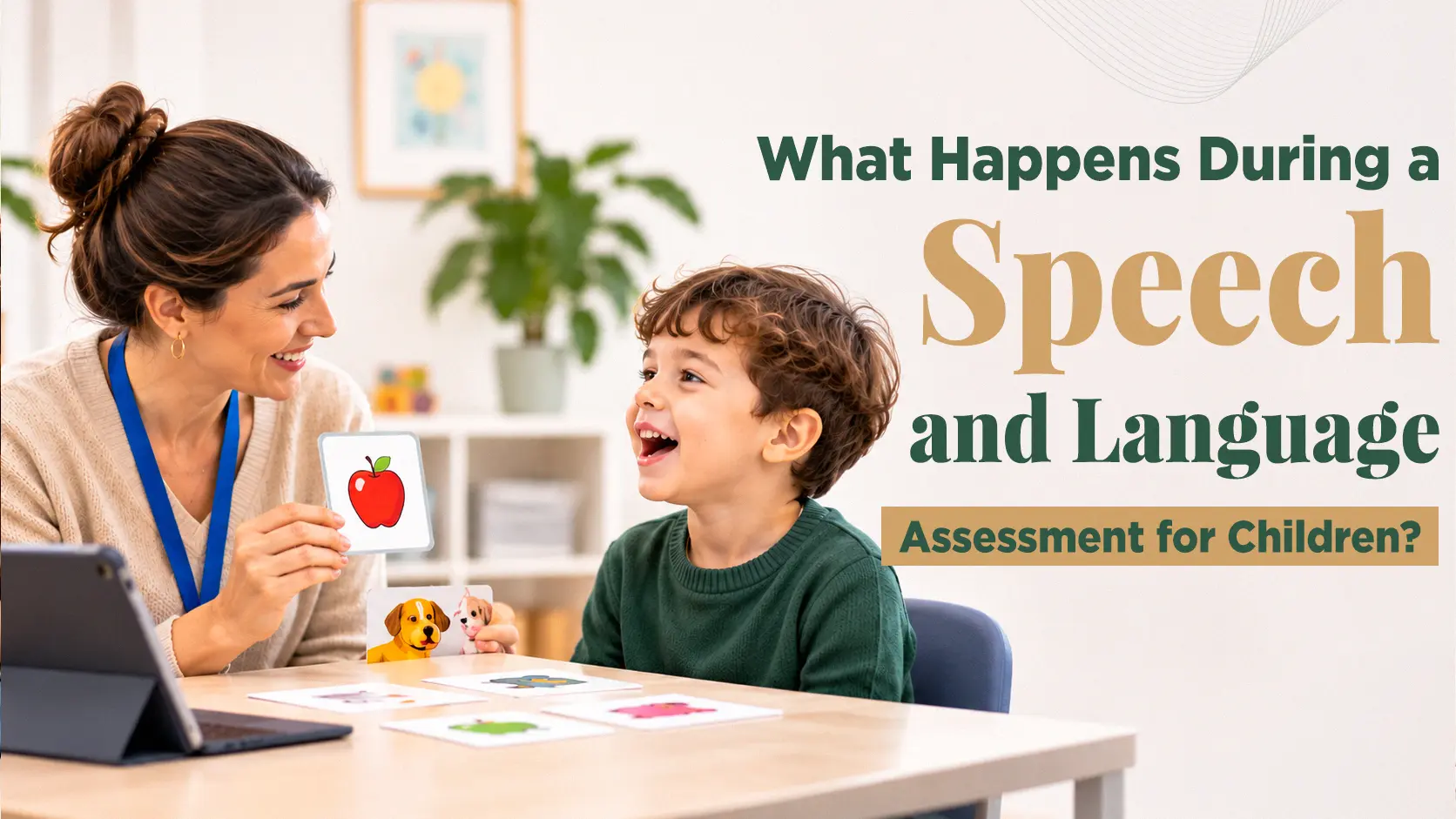
A speech and language assessment for children is a comprehensive evaluation conducted by a registered speech-language pathologist (SLP). It helps describe how a child’s communication is developing, identify strengths and areas of difficulty, and show whether extra support may be helpful.
Depending on the child’s age and needs, it may include caregiver interviews, play-based observation, informal activities, standardized assessment tools, and clinical analysis of speech and language skills.
Every assessment is individualized. A toddler with few spoken words may be assessed differently from a school-age child who finds storytelling, speech clarity, or social communication hard.
Clinics also use the terms “speech and language evaluation” and “speech therapy assessment” for this process. This guide covers what to expect at a speech therapy evaluation, from the first conversation to the follow-up.
The process at a glance: Caregiver discussion → Child-centred assessment → Clinical interpretation → Findings and recommendations
When Should You Consider a Speech and Language Assessment for Children?
Many parents are unsure whether their concerns call for an appointment. Talking with an SLP can be a helpful step if your child:
- has difficulty understanding what others say
- uses few ways to share daily needs, such as words, gestures, signs, or pictures
- is hard for family or peers to understand
- has stuttering that continues or causes worry
- finds language challenging at school
Children develop at different paces, and a difference in development does not necessarily point to a disorder. An SLP can help clarify whether support may be useful.
What to Expect During a Child Speech Assessment
Every SLP shapes the session around the child. Still, many assessments for children share the same building blocks:
- Caregiver conversation. The SLP begins by learning about your child’s developmental history and communication milestones. They also ask about hearing and medical history, home languages, previous assessments, and your family’s concerns and priorities. Where relevant, the SLP may also ask about pregnancy and birth history and the supports your family already uses. Understanding how your child communicates at home, in daycare, and at school helps the SLP choose suitable activities.
- Play and observation. For younger children, the SLP may observe communication through play and everyday interactions. This can include how a child asks for things, protests, comments, shares interests, and responds to language. The SLP adapts the interaction to the child’s comfort, interests, developmental level, and communication style. Children, including autistic children, communicate and connect in different ways, and the SLP values all of them.
- Structured tasks. Depending on the child’s age and communication needs, the SLP may use standardized assessment tools, informal language activities, speech samples, storytelling tasks, or play-based observation. These methods give different types of information, so they often work together.
- Speech sounds and oral structures. When speech clarity is a concern, the SLP may assess how a child produces speech sounds in words, sentences, or conversation. The assessment may explore speech sound patterns, intelligibility, and, when indicated, motor speech skills. The SLP may also examine oral structures and functions when clinically relevant. A formal hearing assessment is completed by an audiologist, usually as a separate appointment, and the SLP may suggest one.
- Wrap-up conversation. The SLP discusses your child’s communication strengths, areas where support may help, and initial clinical findings. Some findings take time to finalize, so the SLP explains what comes next and how a written report may be provided.
Two Kinds of Assessment Methods
| Method | What it is | What it can show |
| Standardized tools | Tasks given and scored using set procedures | A comparison with a relevant group of children, when the tool suits the child |
| Informal methods | Language samples, play, caregiver interviews, and everyday communication tasks | How a child communicates in real situations |
Scores from standardized tools may not fully reflect the skills of some children. This includes children who are multilingual, communicate in different ways, or cannot take part in traditional testing formats. The SLP reads any scores alongside observation and caregiver input.
What Does a Speech Therapist Assess in a Child?
A speech therapist, also called a speech-language pathologist, looks at several areas of communication. The SLP selects areas based on the child’s age, individual needs, and your concerns. One appointment may cover only some of the areas below. A language assessment for children may include:
- Receptive language: how a child understands words, concepts, questions, directions, sentences, and stories.
- Expressive language: how a child communicates through gestures, signs, pictures, augmentative and alternative communication (AAC), words, and sentences, including vocabulary, grammar, and storytelling.
- Speech sound production: speech clarity, articulation, sound patterns, and intelligibility.
- Motor speech skills: when clinically indicated, how a child plans and coordinates speech movements, including possible signs of childhood apraxia of speech or dysarthria. This is a specialized assessment, chosen only when a child’s speech patterns call for it.
- Social and pragmatic communication: how a child uses communication for different purposes, joins interactions, shares information, and expresses preferences. The SLP respects that children interact in different ways.
- Play and early communication: for younger children, play, gestures, early reasons for communicating, and understanding of everyday language.
- Fluency: stuttering, repetitions, prolongations, blocks, and the child’s experience of speaking, when concerns are present.
- Voice and resonance: vocal quality, pitch, loudness, or resonance, when indicated.
- Functional communication and AAC: how a child communicates across everyday activities and whether extra strategies or systems could support access and participation.
For school-age children, an SLP may also look at higher-level language skills, such as narratives, making inferences, understanding complex sentences, and organizing spoken information.
Communication Beyond Spoken Words
Communication goes beyond spoken words. Some children communicate using gestures, signs, pictures, communication boards, or speech-generating devices.
AAC includes tools and strategies that support communication when speech alone is difficult. It can include:
- gestures and signs
- picture-based communication
- communication boards
- speech-generating devices and communication apps
- other individualized strategies
Children who are nonspeaking or minimally speaking may use AAC. So may children whose spoken language is emerging or inconsistent. During an assessment, the SLP may explore whether AAC could help a child express themselves and take part in daily activities. AAC can be considered at any stage, whatever a child’s speech or cognitive skills.
How Are Children Assessed at Different Ages?
| Age group | Common format | Often explored |
| Toddlers | Play-based, with caregivers close by | Play, gestures, early words, understanding of everyday language |
| Preschoolers | Games, picture activities, language samples | Sentences, speech sound patterns, following directions |
| School-age children | Conversation, storytelling, language tasks | Narratives, inferences, complex sentences, input from teachers |
These are examples, and the SLP adjusts them to each child.
How to Prepare My Child for a Speech Assessment
Preparation for a speech and language assessment for children takes a few minutes, and every step is optional. The goal is to give the SLP a clear picture of everyday communication.
You may find this checklist helpful:
- Share your main concerns and examples of how your child communicates.
- Bring earlier speech-language, hearing, or developmental reports, if available.
- Tell the SLP which languages your child uses or hears.
- Bring an AAC device or other communication supports if your child already uses them.
- Bring familiar toys or comfort items, when appropriate.
- Share what motivates your child and what helps them feel comfortable.
- Mention any sensory, regulation, attention, or accessibility needs.
School or daycare observations can be useful to share too.
An Optional Note: Moments, Words, Supports
If it helps, you can jot down a short note with three headings before the visit. Moments are times communication goes well or gets hard. Words include sounds, signs, and pictures your child uses. Supports help your child understand or respond. Here is an optional example:
| Moments | Words | Supports |
| Asks for a snack with a point and a sound | “ba” for ball | Understands better when shown a picture first |
| Gets quiet when several people talk at once | “up” with raised arms | Responds well to extra time after a question |
How to Prepare Your Child for a Speech Assessment on the Day
Keep the explanation short and calm. For younger children, you might say, “We’re going to meet someone who will play with you and learn how you communicate.” For older children, explain that a speech-language pathologist will talk with them and complete activities to understand their communication strengths and any challenges.
Your child can answer in their own way, take breaks, and skip questions. The SLP can adapt the assessment to your child’s needs.
What Happens After the Assessment?
After a speech and language assessment for children, the SLP reviews the findings with you and talks about your child’s strengths and support needs. Recommendations are individualized and reflect the findings and your family’s priorities. They may include:
- speech-language therapy
- parent coaching
- communication strategies for home or school
- AAC exploration or support
- monitoring communication development
- referral to another healthcare professional
- further assessment, when needed
Recommendations for some children focus on monitoring or caregiver strategies, with ongoing therapy added only if needed.
Speech and Language Assessment for Children at Aria Integrated Care
At Aria Integrated Care, registered speech-language pathologists take an individualized, family-centred approach to understanding each child’s speech, language, and communication needs. A speech assessment for kids may include caregiver discussions, play-based observation, structured activities, and formal or informal assessment methods. The mix depends on your child’s age, developmental profile, and areas of concern.
After the assessment, your SLP discusses the findings and highlights your child’s strengths. They also recommend practical next steps to support communication at home, at school, and across everyday routines. Our team can explain applicable fees, report arrangements, and next steps.
If you are unsure whether to book, our guide to speech delay vs. language delay describes common differences. Our overview of pediatric speech therapy explains what support can look like afterward.
Concerned about your child’s speech or language development? Contact Aria Integrated Care to learn about our pediatric speech and language assessment services.
Frequently Asked Questions
1.How long does a speech assessment take?
The length of a speech evaluation for children depends on the child’s age, developmental needs, communication concerns, and assessment methods. Some assessments can be completed in a single appointment, while broader evaluations may take extra sessions. Your SLP will explain the recommended process.
2.What does a speech and language evaluation for toddlers involve?
For toddlers, assessments are often play-based and may involve toys, books, and familiar activities. The SLP observes how the child communicates needs and interests, understands language, uses gestures or words, and takes part in interactions. Caregivers play an important role by sharing examples of communication during daily routines.
3.Does my child need to speak during the assessment?
Children who are nonspeaking or minimally speaking take part through gestures, sounds, pictures, or devices. A child who is shy, anxious, or quiet during the session can still provide useful information through observation and caregiver input. If the SLP needs further information to reach conclusions, an extra appointment may be suggested.
4.Can a speech assessment take place at home or online?
A pediatric speech assessment may be offered in different settings, including clinics, homes, or virtually, depending on service availability and clinical suitability. Your SLP can help determine which format fits your child’s needs. A virtual assessment may suit some situations, though it may not suit every clinical concern or standardized test.
5.Is the assessment a test my child can pass or fail?
A speech and language assessment for children is a way to understand how your child communicates today, identify strengths and support needs, and guide recommendations. Standardized tools may produce scores, and the SLP interprets those scores alongside observation and caregiver input. Results can change as a child grows.
6.What happens after the assessment?
The SLP reviews the findings with you and shares your child’s strengths, support needs, and recommendations. Options may include therapy, parent coaching, communication strategies, AAC support, monitoring, referral, or further assessment. Any recommendation reflects the findings and your family’s priorities.
7.What if my child refuses to participate or becomes upset?
A speech and language assessment for children can be adapted. SLPs can offer breaks, change activities, involve caregivers, and use other ways to gather information. Sometimes an extra appointment is a good option.
8.Does every child need a standardized speech-language test?
Assessment methods are chosen based on the child’s needs. Standardized testing suits some children and situations, while others are assessed through observation, language samples, and caregiver input.
9.Will my child need speech therapy after the assessment?
Some children benefit from therapy, while others may need monitoring, caregiver strategies, further assessment, or other support. Recommendations depend on the findings and your family’s priorities.