October 8, 2026
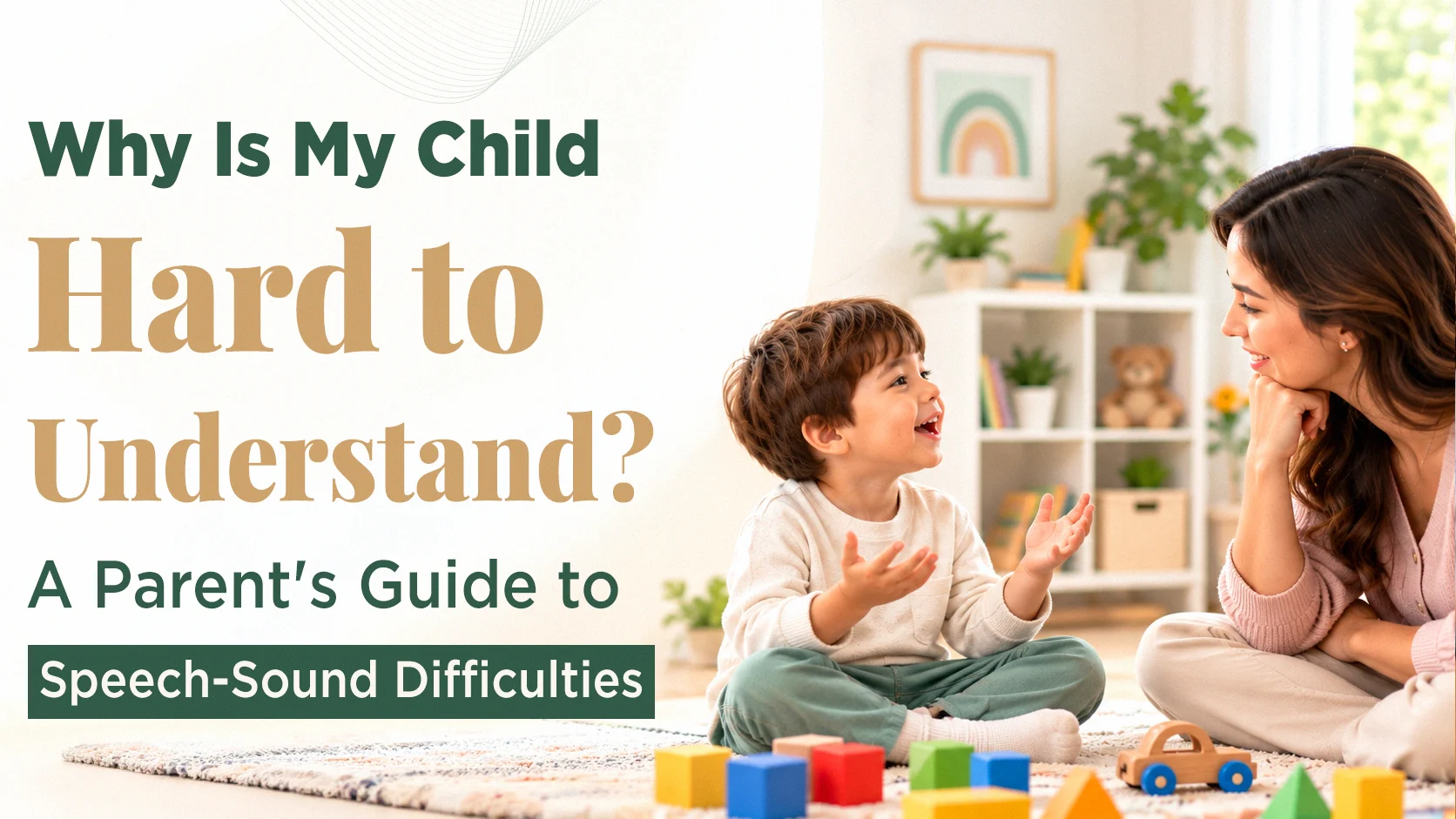
Your child says something at the dinner table. You catch half of it. You ask them to repeat it, and the second try isn’t much clearer. Maybe a grandparent leans over afterward and asks, “What did she say?” It happens more often than you’d like, and it’s starting to nag at you.
If you’ve found yourself wondering why your child’s speech is hard to understand, you’re not alone in asking. It’s a fair question to bring to someone who can actually look closely at what’s going on.
What “Hard to Understand” Means
When people describe a child as hard to understand, they’re usually talking about something speech language pathologists call intelligibility: how much of what a child says can be followed by a listener, without extra context or guessing.
A parent who spends all day with a child often understands more than a teacher or a stranger would, simply because they’ve had more practice filling in the gaps. That’s useful information in itself. If unfamiliar listeners struggle more than familiar ones do, it’s often a sign that certain sounds or sound patterns aren’t landing the way they’re meant to yet, not that something is fundamentally wrong.
Common Speech Sound Difficulties
Speech sound difficulties in young children usually fall into a few recognizable patterns. Kids don’t produce errors randomly. There’s often a pattern behind it, and naming the pattern is part of what an assessment does.
- Substitutions: one sound replaces another, like saying “wabbit” for “rabbit” or “tup” for “cup.”
- Omissions: a sound gets dropped entirely, especially at the end of words, like “ca” for “cat.”
- Simplifications: harder sound combinations get smoothed out, like “gween” for “green” or “poon” for “spoon.”
None of these on its own means a child has a speech sound disorder. Plenty of these patterns are a normal part of learning to talk. What matters more is how many patterns show up, how consistent they are, and whether they fit what’s expected for the child’s age.
Speech Clarity by Age
Speech generally becomes clearer through the toddler and preschool years. The pace varies from child to child.
Clarity can also change with the listener and the situation. A child may be easy to follow at home and harder to follow with unfamiliar people, in a noisy room, or when tired or excited. Unclear speech in toddlers is common, and it does not always point to a concern.
You do not need to decide whether your child meets a certain age or percentage. If you are concerned about how well others understand your child, a speech-language pathologist (SLP) can help you make sense of what you are hearing.
Warning Signs: When Parents Should Consider an Assessment
A few signs of speech sound disorder in children may be worth raising with an SLP:
- Family members frequently ask the child to repeat themselves
- Speech is noticeably less clear than same-age peers
- Certain sounds are consistently missing past the age they’re typically expected
- The child seems frustrated when they’re not understood
- Speech hasn’t changed much over several months
Developmental Factors: How Speech Sounds Develop
Speech sounds don’t develop all at once, and not in the order a parent might expect. Sounds like p, b, and m tend to come in early, while sounds like s, r, and th typically take longer to master, sometimes well into early elementary school.
A child mixing up “th” and “f” at four isn’t unusual. The same substitution at eight might be worth a closer look. Hearing, motor coordination in the mouth and jaw, and general language development all play a role, and they don’t always develop at the same pace within the same child.
For Multilingual Families: A child’s speech may reflect the sounds and patterns of the languages or dialects they hear and speak. These differences alone do not mean that a child has a speech sound disorder.
When to Get a Speech Assessment: The Role of an SLP
An SLP’s assessment looks at more than which sounds a child gets wrong. It may include listening to the child talk in different contexts, considering the child’s oral structures and movements when relevant, and reviewing speech patterns in relation to the child’s development and communication needs. The SLP may also review the child’s hearing history and recommend a hearing assessment if indicated.
An assessment can help determine whether what you’re noticing fits within typical variation or whether targeted support could be helpful. The assessment is tailored to the individual child rather than using the same set of checks for everyone.
For families in Greater Vancouver, assessments can happen in the home, in the same environment where a child already plays and communicates naturally. Across British Columbia, services may also be available virtually, which can help families manage scheduling around school, work, and other therapies.
Speech Therapy & Support: Common Approaches and Home Practice
Speech sound disorders vary widely, so speech therapy approaches vary too. Once an assessment identifies a pattern, therapy is built around that specific pattern rather than a blanket approach.
Articulation-based approaches tend to fit when a child has trouble with a small number of individual sounds. Phonological approaches, which target patterns across groups of sounds rather than one at a time, tend to fit when several sounds are affected in a similar way. Which approach applies depends on what the assessment finds, not on the child’s age alone.
Between sessions, home practice usually looks smaller than parents expect. A five-minute stretch of naming pictures together, or gently repeating a word back with the correct sound modeled, can support what’s being worked on in session.It isn’t about correcting every mispronounced word throughout the day. That tends to build frustration rather than progress. To see what a first session may involve, read our guide to pediatric speech therapy.
Common Misconceptions About Unclear Speech
Another: children grow out of every unclear speech pattern eventually. Some do. Others don’t, and waiting past the age a sound is typically mastered can mean starting support later than it might have helped.
A third: if a child understands what’s said to them, speech itself isn’t a concern. Understanding language and producing clear speech are two different skills. A child can follow instructions perfectly and still be difficult to understand out loud.
What Parents Can Do Next
If you’re concerned about your child’s speech clarity, you don’t need to wait for a particular birthday to ask an SLP. An assessment can provide information about what you’re noticing and whether any support may be helpful.
Our speech-language pathology team offers assessments in-home across Greater Vancouver and virtually across British Columbia, built around where your child already talks, plays, and lives day to day.
Book a conversation with our speech therapy team to find out what’s going on and what support, if any, could help.
Frequently Asked Questions
1. When should I consider a speech assessment for my child?
Consider speaking with an SLP if your child is frequently difficult to understand, seems frustrated when communicating, or you have ongoing concerns about their speech development. There is no need to wait for a specific age or percentage cutoff to ask for guidance.
2. What happens during a speech sound assessment?
An SLP may listen to your child’s speech in different contexts and look at speech patterns in relation to their development and communication needs. When relevant, the SLP may consider the child’s oral structures and movements, review hearing history, and recommend a hearing assessment if indicated. The assessment is tailored to the child rather than using the same set of checks for everyone.
3. How can I support my child’s speech at home?
Keep practice short and low-pressure. You can name pictures or everyday objects together, model a sound or word clearly, and give your child opportunities to communicate without correcting every mispronunciation. If your child is receiving therapy, the SLP can suggest activities that support the goals being worked on.
4. Do children outgrow speech sound errors with age?
Some speech sound patterns change as children develop and may resolve within typical developmental timeframes. Others may continue longer or benefit from targeted support. An SLP can help determine whether a child’s speech patterns are consistent with their stage of development.
5. How are multilingual speech differences considered during an assessment?
A multilingual child’s speech may reflect the sounds and patterns of the languages or dialects they hear and speak. These differences alone do not mean that a child has a speech sound disorder. An SLP can consider the child’s language background and communication across their languages or dialects when interpreting speech patterns.
6. Is a speech delay the same as a speech sound disorder?
Not necessarily. “Speech delay” is a broad term that may be used when a child’s speech development is progressing more slowly than expected, while a speech sound disorder specifically involves ongoing difficulty producing speech sounds or using sound patterns. Speech and language development can also overlap, so an SLP looks at the child’s overall communication profile rather than relying on a label alone.
7. How are multilingual speech differences considered during an assessment?
A multilingual child’s speech may reflect the sounds and patterns of the languages or dialects they hear and speak. These differences alone do not mean that a child has a speech sound disorder. An SLP can consider the child’s language background and communication across their languages or dialects when interpreting speech patterns.
8. Is a speech delay the same as a speech sound disorder?
Not necessarily. “Speech delay” is a broad term that may be used when a child’s speech development is progressing more slowly than expected, while a speech sound disorder specifically involves ongoing difficulty producing speech sounds or using sound patterns. Speech and language development can also overlap, so an SLP looks at the child’s overall communication profile rather than relying on a label alone.