Cerebral Palsy & Motor Speech Therapy
Individualized motor-speech and AAC support for people with cerebral palsy, across the lifespan.
Signs Someone May Benefit From a Motor-Speech Assessment
Speech and communication needs connected to cerebral palsy look different for each person. A motor-speech assessment can help clarify what's happening and what might help. The following may be worth discussing with an SLP:

Cerebral Palsy and Motor-Speech Disorders
Cerebral palsy and motor-speech disorders are closely connected, but they aren't the same thing. Here's how each affects communication.
Cerebral Palsy
Cerebral palsy affects coordination and control of movement, including posture, breathing, voice and speech. Presentation varies by person.
Posture and breathing
Cerebral palsy may affect the muscle control needed to support speech.
Voice and resonance
Voice may sound strained, quiet or breathy depending on presentation.
Movement varies by person
No two people with cerebral palsy have the same speech profile.
Not about cognition
Speech clarity and physical movement should not be used to make assumptions about a person's intelligence or understanding. Some people with cerebral palsy may also have language, cognitive, sensory, or learning differences, which should be considered individually during assessment.

AAC for Cerebral Palsy
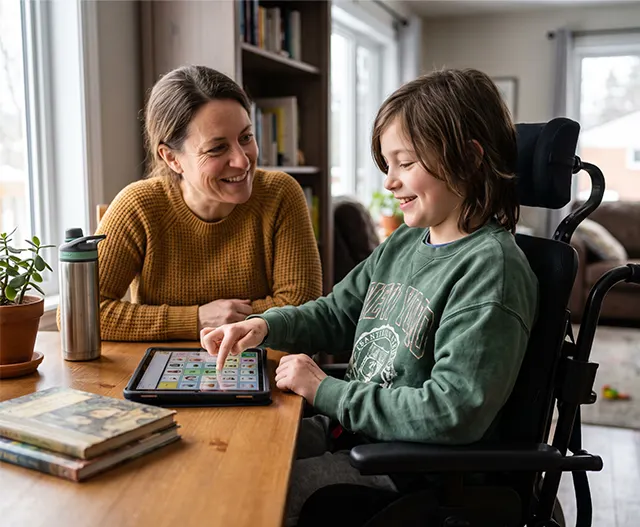
AAC may supplement speech or provide a person's primary and most reliable way to communicate. Depending on the client's needs, Aria may explore low-tech supports and selected tablet-based AAC applications available on our devices.
Aria does not currently provide specialized eye-gaze or switch-access assessment. Referral to another specialized AAC service may be recommended when alternative access or more extensive equipment trials are required.
Approaches We Draw From
Treatment may draw from several approaches, selected by the SLP based on each person's profile, goals and response to cueing.
PROMPT-informed techniques
PROMPT-informed techniques may be available depending on the assigned clinician's training and availability.
Kaufman Speech to Language
Kaufman Speech to Language Protocol treatment resources may be incorporated for appropriate pediatric clients to help shape functional word approximations and progressively more complex speech movements.
Oral-placement principles
Oral-placement principles may be considered when a client requires additional tactile or proprioceptive information to establish speech-related placement and movement.
Tactile cueing and consent
Tactile cueing is used only when clinically appropriate and with informed consent and the client's ongoing assent. Clients may decline or withdraw permission for touch at any time, and other cueing methods may be used.
Our Motor-Speech Approach
Motor-speech therapy is individualized according to the client's speech profile, functional communication needs and goals. Sessions may combine structured motor practice, meaningful words and phrases, everyday communication activities, AAC and communication-partner coaching.
Motor speech is considered within the person's broader communication profile. Where relevant, the SLP may also consider language, cognitive-communication, AAC, and participation needs or recommend another appropriate service.
Possible components may include:

What Happens During the Assessment
Learn more about how cerebral palsy may be affecting speech and communication through an individualized SLP assessment.
01
Background and Priorities
We discuss relevant medical and developmental history, current communication methods, concerns, strengths and meaningful goals.
02
Motor-Speech Observation
The SLP observes relevant aspects of posture, breathing, voice, resonance, articulation, speech movement and speech rhythm.
03
Functional Communication
We observe how the person communicates during meaningful activities and with familiar communication partners.
04
Speech and Communication Samples
The SLP gathers samples across relevant sounds, words, phrases, sentences or conversations and considers the person's use of AAC.
05
Standardized or Structured Assessment
When appropriate, the SLP may use standardized or structured motor-speech assessment activities. DEMSS is available for clinically appropriate pediatric referrals.
We may ask about feeding or swallowing as part of the health history. If concerns are reported or observed, we may recommend consultation with a physician or appropriately qualified feeding and swallowing professional. Feeding and swallowing assessment is not currently offered by Aria.
All initial assessments, diagnoses, and treatment plans are completed by an SLP.
Possible Areas of Progress
Progress differs for every person and cannot be guaranteed. Goals may focus on speech, communication strategies, AAC, participation, or a combination of these areas.
Why Families Choose Aria Integrated Care
Services are provided by registered speech-language pathologists and, when appropriate, speech-language pathology assistants working under SLP direction and supervision. Referrals are matched according to the clinician's training, competence, location, and availability.
Family-centred care
Support built around the person and the people who communicate with them.
Collaborative care
With consent, our clinicians may collaborate with occupational therapists, physiotherapists, physicians, educators, and other members of the client's care team when appropriate
AAC considered alongside speech
AAC is explored when it may improve communication access.
Practical, everyday strategies
Strategies that can be used across everyday routines and environments.
BC-wide teletherapy
Virtual sessions across all of BC, when clinically appropriate.
Motor-Speech Support Across Greater Vancouver and BC
Motor-speech needs may continue across the lifespan. Services are available to children, adolescents, and adults when the referral falls within the clinician's competence and current availability.
In-home services
Available across Greater Vancouver, subject to clinician availability and clinical fit. In-home services allow assessment and therapy to occur within a familiar environment. This can reduce travel demands and help the clinician consider communication during everyday activities. With consent, the SLP may collaborate with occupational therapists, physiotherapists, and other professionals regarding positioning, motor access, and communication participation.
Virtual services
Available across BC when clinically appropriate. Sessions may include motor-speech practice, AAC support and coaching, based on the client's goals and access needs.
Booking, Referrals, and Reports
Clients and families may contact Aria directly for a consultation or SLP assessment. Depending on the person's health history, funding requirements, or clinical presentation, the SLP may request additional medical information or recommend consultation with another professional.
All initial assessments, diagnoses, treatment plans, and clinical recommendations are completed by a registered speech-language pathologist. Following assessment, an SLPA may provide selected treatment activities when the SLP determines that delegation is appropriate. The SLP remains responsible for direction, supervision, progress review, and changes to the treatment plan.
Written assessment reports are available when needed. Report preparation is billed separately according to the SLP's applicable professional rate and the time required. Fees will be discussed in advance.
Frequently Asked Questions
Direct answers to common questions about cerebral palsy, motor-speech therapy, AAC, and how Aria's services work.
Communication Support Built Around the Individual
Support built around the person, not a single method. Book a free 15-20-minute consultation to talk about what might help.